Work starting 4.3.26 – concrete rendering on upper storey removed, timber frame inspected and repaired, lime rendering applied, lime plaster to finish. Also upper window frames repaired. Hope to finish by end of April (weather etc permitting).
The listed building application and the works
The listed building application for work on Magpie Cottage has now granted (ref DC/25/01885, you can search for it here).
Magpie Cottage is actually in two halves, which can be seen from the ‘step’ in the jetty along the top of the ground floor.
The right hand side of the house (as you look at it) is thought to include ‘part of a much larger timber-framed house on the same corner and belonged in the 16th century to the wealthy White family of butchers’.
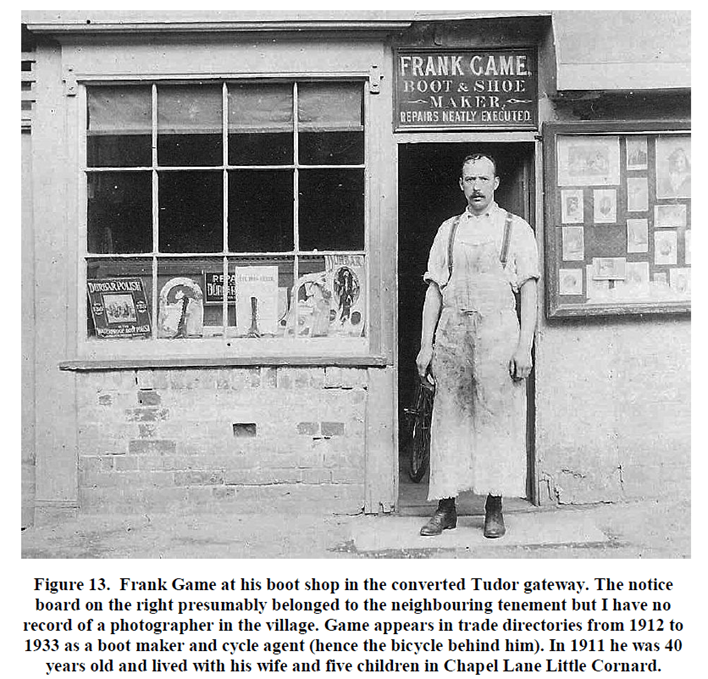
The left side was originally ‘a jettied gateway with a single first-floor chamber above a lower storey that was entirely open to the street on the south and the butcher’s yard to the north’ and is thought to date from a slightly later period than the right hand side.
This information is from a heritage statement report about the house by Leigh Alston, Architectural Historian. You can read the summary from Leigh’s report at the foot of this page, or you can read more about the house’s history in his full report – search using the link above and find it in the supporting documents.
What work is going to be done?
As such it has been around for a while and is in need of an overhaul to make sure it lasts another 500 odd years. On the front of the house concrete rendering has been used rather than the breathable traditional lime, and over time it has cracked and is letting in water. The damaged window sills on the upper storey have contributed to this. The trapped water has led to some damage to the timber frame of the house (so far not too serious thankfully) and this needs repairing, and then new lime render needs applying to the outside.
The cottage will look the same as before, only with less membranes stuck to the outside of it, a new light on the front and the original patterning in the plaster, mostly lost to time, hopefully returned.
Work will take place later this summer now the application has been granted. Scaffolding and skips will be inevitably be involved, and we will do our utmost to stay out of everyone’s way.
More about the background of the house
Summary (from heritage statement)
Magpie Cottage lies in the historic centre of Bures immediately opposite St Mary’s Church.
It consists of two timber-framed, jettied and rendered structures of equal length distinguished only by the greater height of the jetty to the left and a slight change of axis. The right-hand range contained a single room on each floor and originally formed part of a much larger house that extended to the corner of the High Street. Described in the manorial records as a ‘capital messuage’, this was the home of the wealthy White family of butchers and cattle famers for most of the 16th century and was known as Whites at least until the mid-17th.
It was later divided into multiple cottages of which the present no. 11 contained two before those on the corner were replaced in 1880 by the brick grocery shop at no. 13. The same records refer to significant building work at the corner site in or shortly before 1506 which included a new ground sill, and the crown-post roof structure at Magpie Cottage suggests its right-hand section survives from the same remodelling. Its exceptionally narrow width of just 11.5 ft on the lower storey is surprising for the apparent parlour of a high-status house, as are its plain ceiling joists and diamond window mullions, so it may have been designed instead as an additional storage room. The upper storey appears to have been reached via an external stair in a highly unusual manner that suggests it formed the rare ‘guest chamber’ mentioned in John White’s will of 1563 which contained his best bedstead and a set of wall hangings. This stair rose against a weathered left-hand gable which is now preserved within the roof of a gatehouse extension built no later than the early-17th century in the former entrance to the rear yards. The new structure was entirely open on the ground floor, hence its taller jetty, and its first-floor chamber was linked to that of its older neighbour by the stair door. Most of the gateway has been converted into the modern sitting room, but a narrow passage to the left is still shared by the adjoining house at no. 10.
As the last remaining fragment of a well-documented Tudor house, Magpie Cottage is of considerable local significance and its weathered internal gable illustrates the appearance of local village streets in the 16th century.

Figure 1 Magpie Cottage in the 1920s
2 from report by Leigh Alston
 Catherine Doran Proofreader